📍The Netherlands
The Rijksmuseum is a national museum in Amsterdam, constructed in 1808 by King Louis Bonaparte of the Netherlands. It is quite large, and currently houses about 3,000 works of art.
Since there were many different artists and types of paintings, it is impossible to analyze them one by one. Still, among the many paintings, I will discuss those that were impressive because they were connected to art history and vanitas paintings that contain the historical background of the Netherlands.
Vanitas is a subject that can be often found in the Netherlands’ still life paintings from the 16th and 17th centuries. It generally refers to the motif or theme of the transience of life and the inevitability of death in the field of art, and vanitas still life paintings centered around this were often painted during the historical period of the Black Death and the Thirty Years’ War in medieval Europe. The etymology of vanitas comes from the Latin adjective vanus, meaning “empty,” and is said to mean “emptiness,” “vanity,” or “worthlessness,” and from a traditional Christian perspective, the pursuit of worldly goods and the temporary and worthless. In the Bible, there is a phrase in Ecclesiastes 1:2, “Vanitas vanitatum, et omnia vanitas,” which means “Vanity of vanities, all is vanity.” This phrase was used as a central theme in vanitas still life paintings.
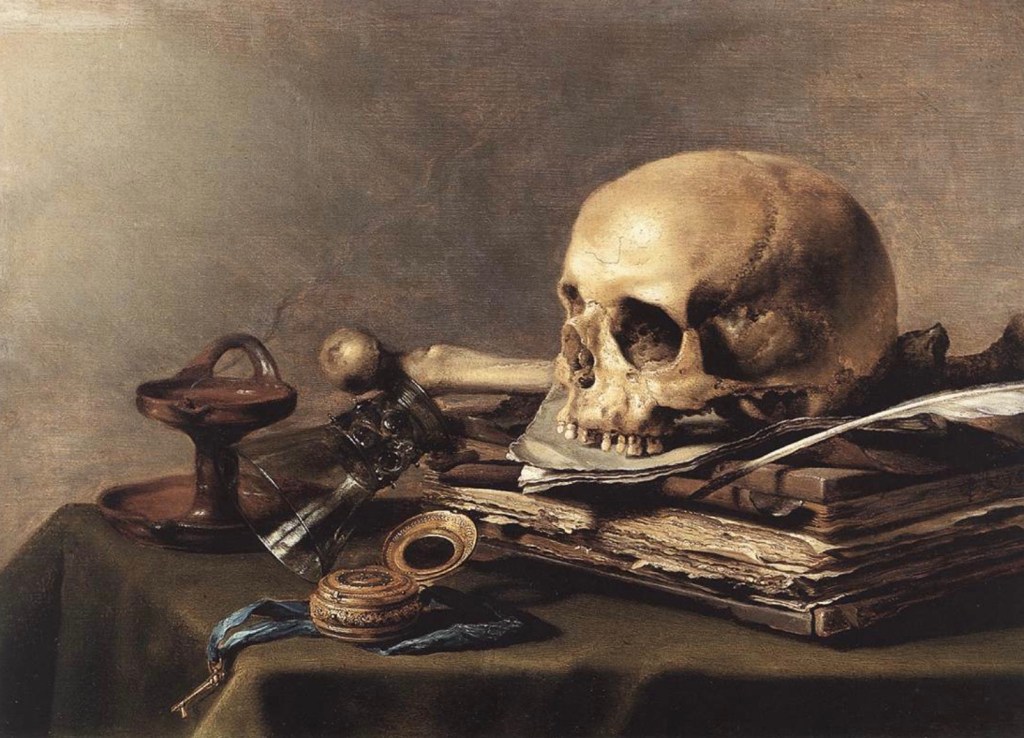
Vanitas(1630)-Peter Clasez
The characteristics of vanitas still lifes are restrained and use darker colors than those painted previously. Skulls often appear as a subject to express the artistic meaning of vanitas, the ‘transience of life’. Here, what the skull symbolizes is not simply death and the futility that follows, but also the sense of transience felt from the remains left behind after death, that nothing can exist forever. In particular, in the historical view of medieval Europe, where the Black Death and the Thirty Years’ War were rampant, the skull evokes countless nameless deaths and acts as a symbol that testifies to them. In addition, the frequently used subjects such as hourglasses, withered flowers, and candles all have in common that they cannot maintain their current state as it is and change with the passage of time. The act of the sand slowly flowing down from the hourglass, the process of the flower gradually withering, and the candle that goes out when the candlestick melts – all of these things express that eternity does not exist in this world, and make us imagine the emptiness and meaninglessness after all of these objects are changed from the ‘present tense’ to the ‘past tense’.
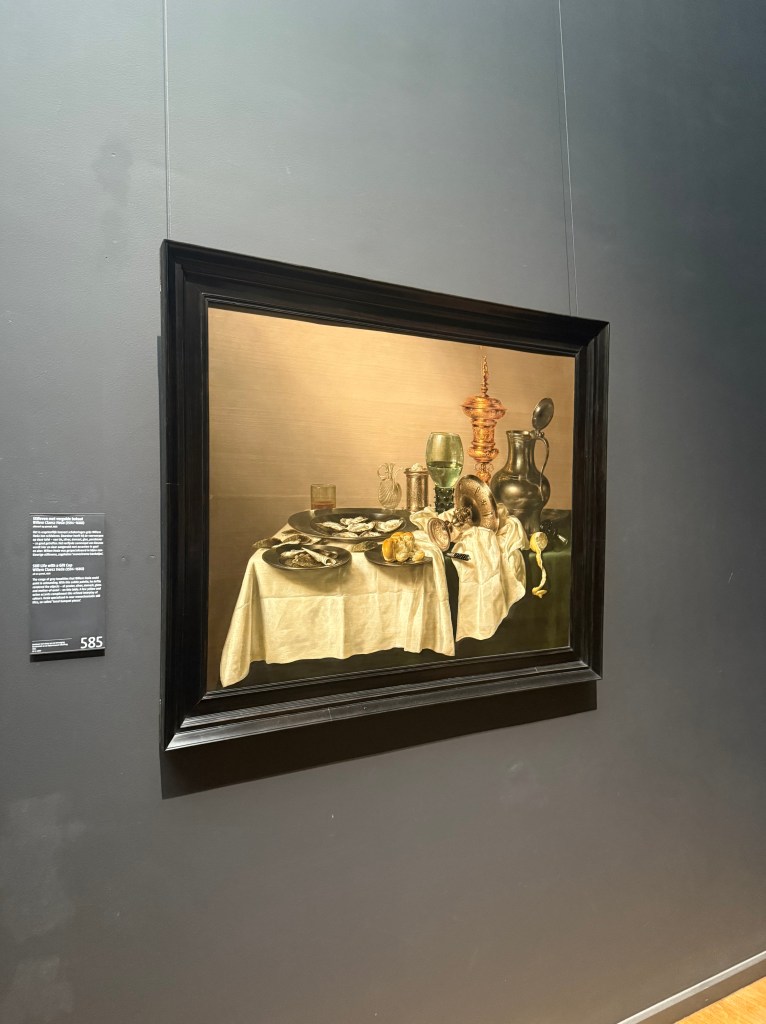
Still life with oysters, a rummer, a lemon and a silver bowl (1634)-Willem Heda
This work can be specified as a ‘vanitas still life painting’, but it might be drawn at the transition between vanitas still life painting and original still life painting. There is neither the Skull nor the flower, which was often drawn in Medieval European still life. However, it still uses refined colors and textures. All the objects in the picture are drawn in monochrome, and the texture of the dishes and tablewares, as even the tablecloth, gives the same feeling for the textures. This might be analyzed as the author’s own way to express things, but on the other hand, this painting might be in the process of moving from one step to another. However, looking at the drawn image, like a photograph, and is described so neatly and precisely that it seems like it could come out at any moment.
The vanitas still lifes I saw at the Rijksmuseum made me think about death and the afterlife. I paused in deep thought, and my attention soon turned to other paintings that had different historical significance.
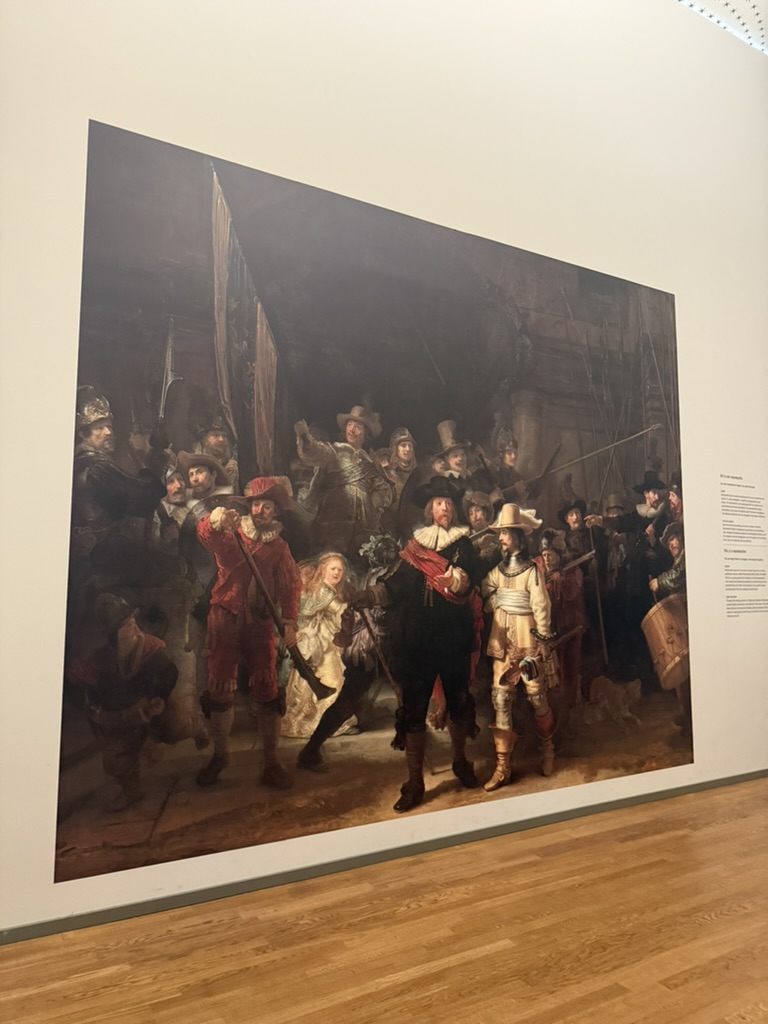
The Night Watch(1642)-Rembrandt
The name of this work is “The Night Watch.” It was supposed to describe the preparation of a march in the daytime, but the strong contrast and glaze on the surface made throughout time resulted the drawing look even darker. And it started to be called as “The Night Watch”. This is a painting by Rembrandt depicting the Amsterdam Citizens’ Defense Force. It is considered a masterpiece because of Rembrandt’s excellent expression of light and shadow, the dynamic appearance of the figures, and the social aspects of the time. By that time what the Citizens’ Defence Force did was protecting doors and taking charge in public services like public safety and fire. But they are said that the focus was on protecting citizens and ceremonial activities rather than combat. Actually, the picture above is the copy of the original one, and the real one is in its process of restoration.
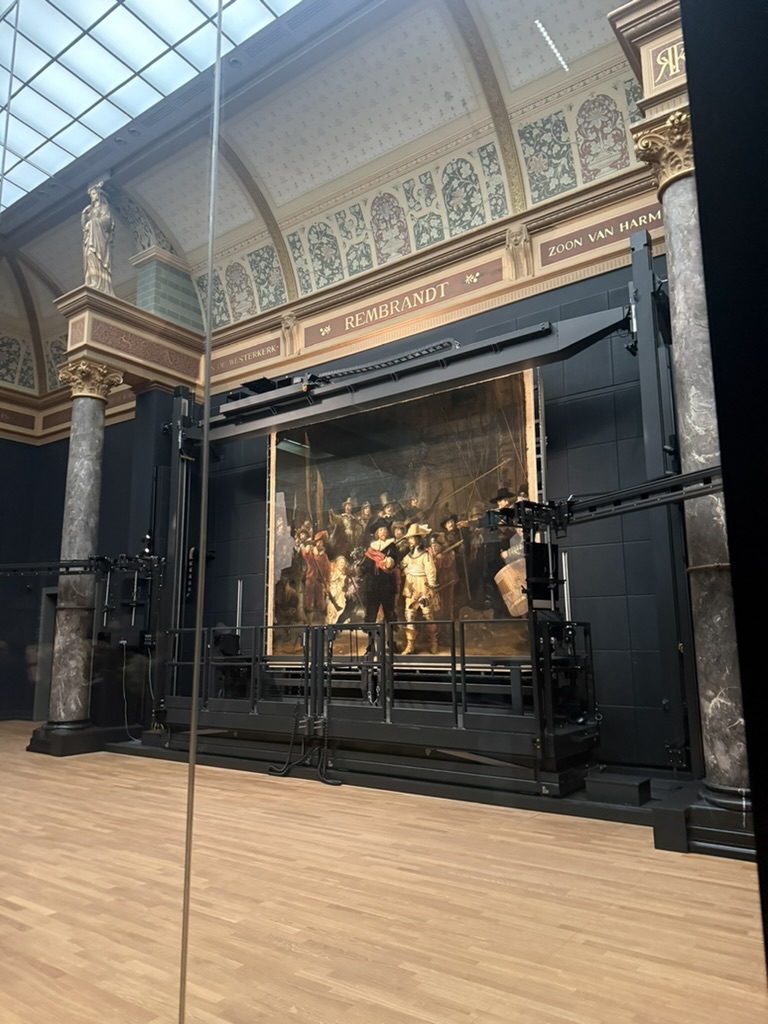
This is the original one, which is in its process of restoration. The description says that the work has experienced various challenges within 400 years, so the museum is trying to find out clearly the current situation of the work and the best way to treat the drawing. Furthermore, conservation experts are trying to remove old varnish and any subsequent overpainting. I didn’t know that this painting was damaged, but as I researched it, I was able to know that it was damaged by the change in color caused by chemical reactions and many other cases such as a man trying to destroy the work by a kniefe in 1911. Also during the World War II, in the process of storing the painting by rolling it.
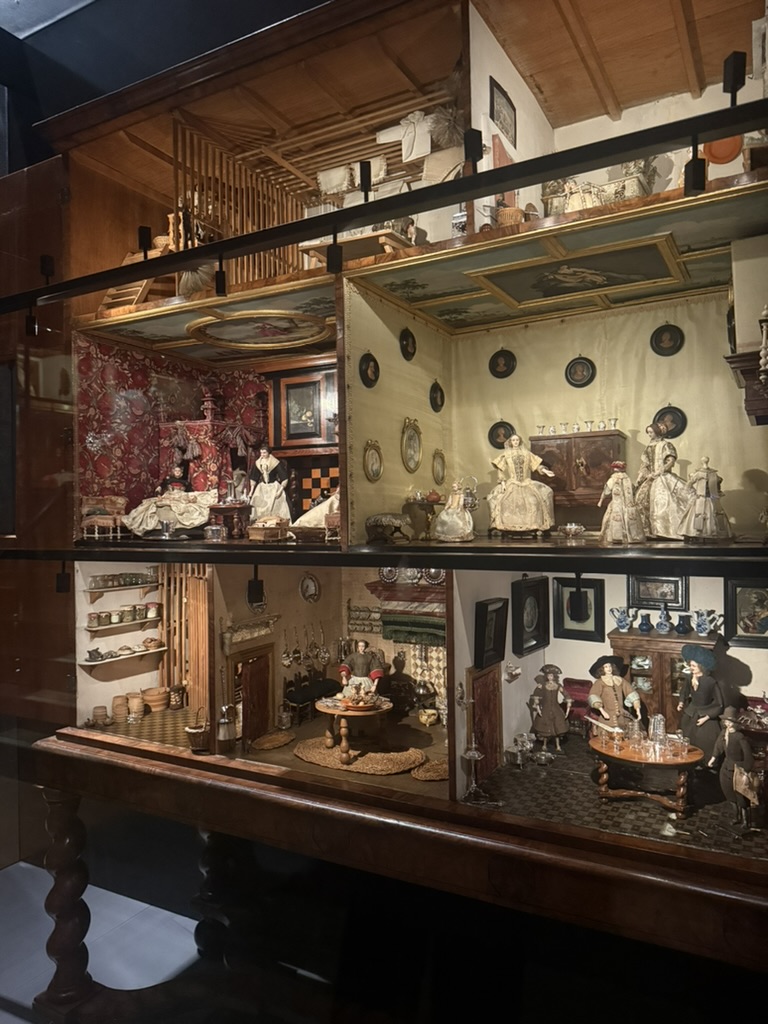
This work is called ‘The Doll’s House”. It looks cute and adorable, but this piece actually represents the structure of the homes of the upper class in Amsterdam at the time, so it is very luxurious and elegant when viewed up close. The furniture, people, the atmosphere of the room, and even the wallpaper are all made with tiny grains of rice and great detail. As I looked closely, I felt myself wanting to make a dollhouse by myself.
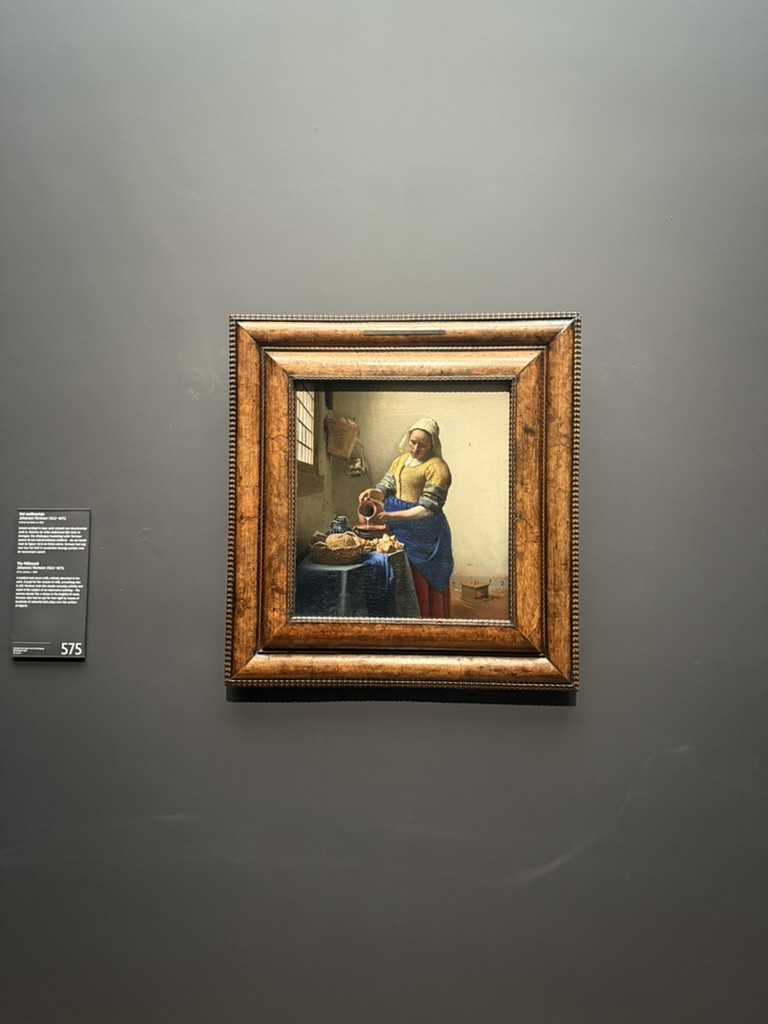
The Milkmaid(1657-1658)-Johannes Vermeer
This painting is “The Milkmaid,” an oil painting by Johannes Vermeer, who is also famous for his depiction of “Girl with a Pearl Earring”. Along with Rembrandt, Vermeer was a representative painter of the Dutch “Golden Age,” gaining fame for his genre paintings depicting scenes of everyday life. He was particularly famous at expressing light and harmonious color combinations. His signature sense of color, using harmonious blues and yellows, is evident in this work. In this painting, the woman is clad in a yellow jacket and blue apron and stands serenely, like a sculpture bathed in the unwavering light. This characteristic is also evident in “Girl with a Pearl Earring,” and both works exemplify Vermeer’s use of blue and yellow in a profound way.
The Milkmaid is all the more striking for centering not on a queen or noblewoman, but on a commoner, a simple servant woman. She is in the kitchen, having bread and milk in her hand. Rather than a glamorous or idealized beauty, the painting captures the expressions and movements of a woman who could truly exist, releasing a sense of familiarity and realism to the viewer. But it goes beyond mere ordinariness. The soft natural light streaming in from the window delicately envelops her fingertips, the textured wall, and even the jug of milk, creating a still yet profound atmosphere throughout the painting.
Vermeer also meticulously composed the space. The baskets hanging on the wall, the kitchen utensils, and even the floor tiles on which she stands are arranged within a carefully calculated composition, making the simplicity of everyday life feel like a holy still life.
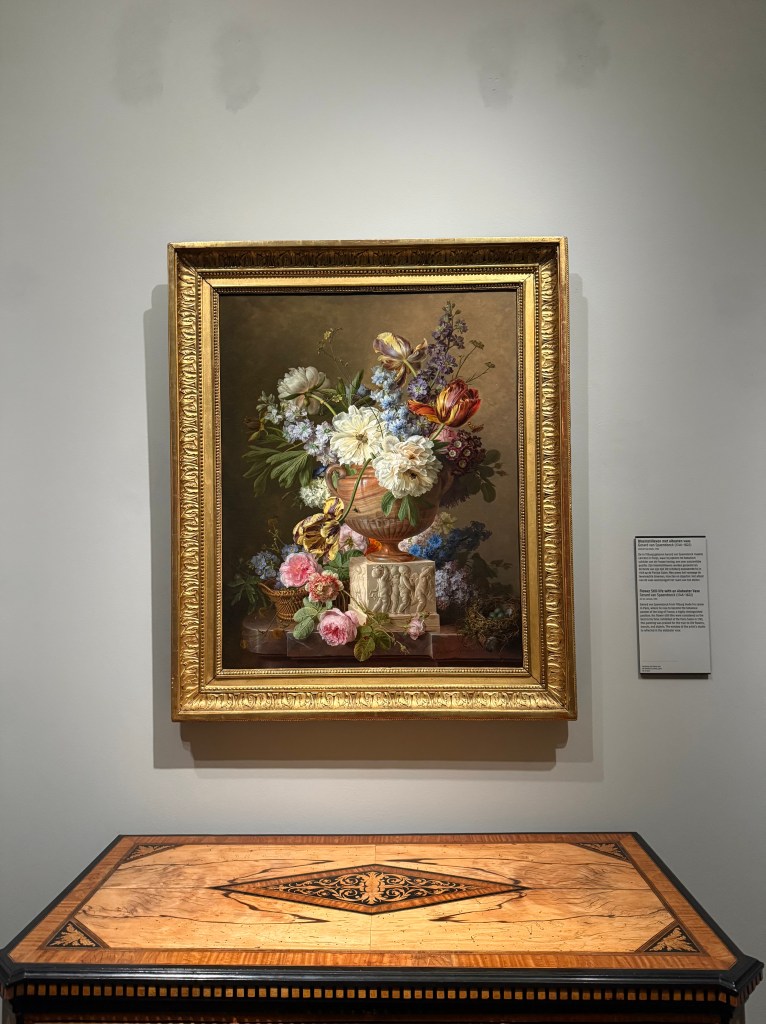
Still Life of Flowers in Alabaster Vase(1783) -Gerard van Spaendonck
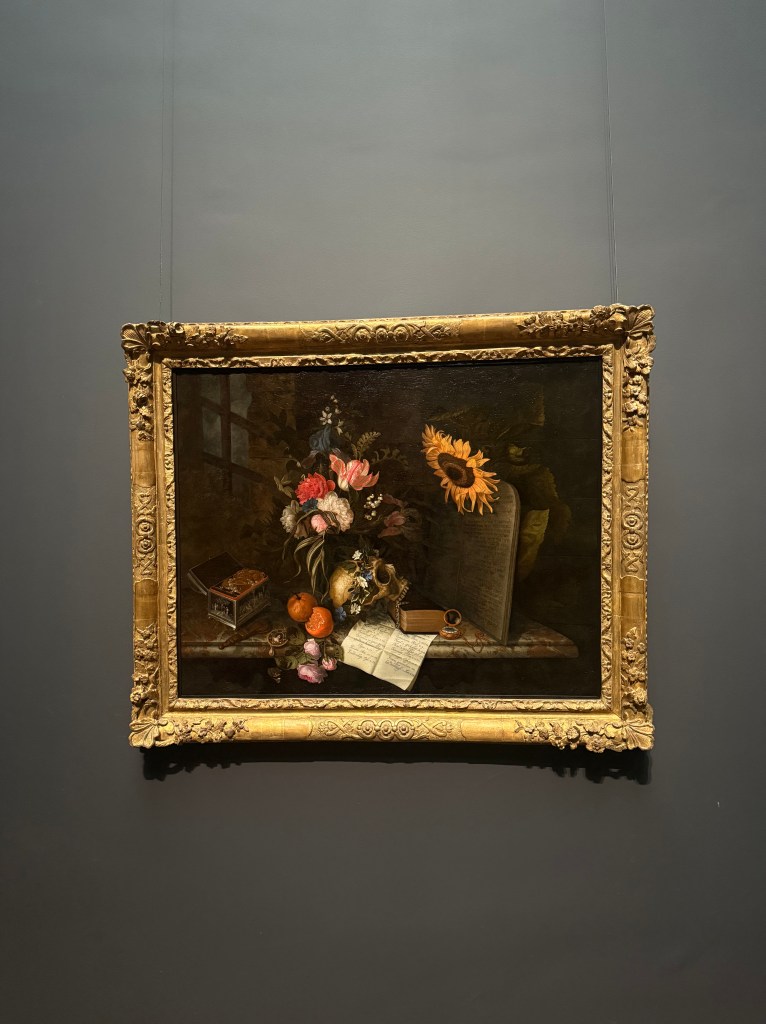
Stilleben-Maria van Oosterwijk Vanitas
These two works are grouped together because they are both still lifes depicting flowers. While they are stunning enough to be seen from a distance, the realistic depiction of the flowers makes them seem more real than just paintings. Neither painting has a clear light direction, but the detail of each individual still life, beyond the flowers, makes them seem as if they’re truly popping out of the canvas. Defining the light direction and exaggerating it to create masses can be a way to express three-dimensionality, the ability to create a sense of realism through such depiction alone is truly remarkable.
There were many other famous works besides the ones mentioned above, including many by one of my favorite artists, Monet. However, the museum itself was so large that I didn’t have the time and space to organize them all this time.
While viewing contemporary and modern exhibitions is enjoyable, encountering these classic works deepens my understanding of art and deepens my study of art history. While modern works express personal thoughts more directly, these medieval works capture the social conditions of the time or reflect a certain era-specific sentiment. In that sense, art is not simply painting or creating sculptures but a field that directly touches society, perhaps even going against history, culture, economy, and politics.
 The Palette Passport
Leave a comment