📍The Netherlands
This time, my aunt and uncle visited us from Korea, so we went to Amsterdam for a two-day trip over the weekend. Since it was a short trip, I didn’t get to visit many of the museums I wanted to, but I was still able to visit two of them.
First day, I visited the Van Gogh Museum to see ‘Sag mir wo die Blumen sind’, the exhibition by Anselm Kiefer.
Anselm Kiefer is a German Artist and a Writer. I was not familiar with the artist, but I got to know that he is famous for expressing the dark side and wounds of German history after World War II. Also, he is famous for using straw, grass, and lead in his works to put texture in an interesting way. Since the exhibition was held in the Van Gogh Museum, I was curious about how the two artists were linked, and as soon as I entered, I found a text explaining the link between Van Gogh and Kiefer.
What I understood about the connection between Kiefer and Van Gogh was that they both set up the horizon line either extremely high or extremely low, and accepting literature as a part of art, and expressing that also worked as a resemblance.
I noticed the impression Van Gogh gave to Kiefer while appreciating Kiefer’s works. The most interesting works were the works based on sunflowers. One of them is a drawing, and the other is a sculpture, but they both depict a sunflower’s growth and death in one perspective. It seemed like the life of one plant was captured in two works.
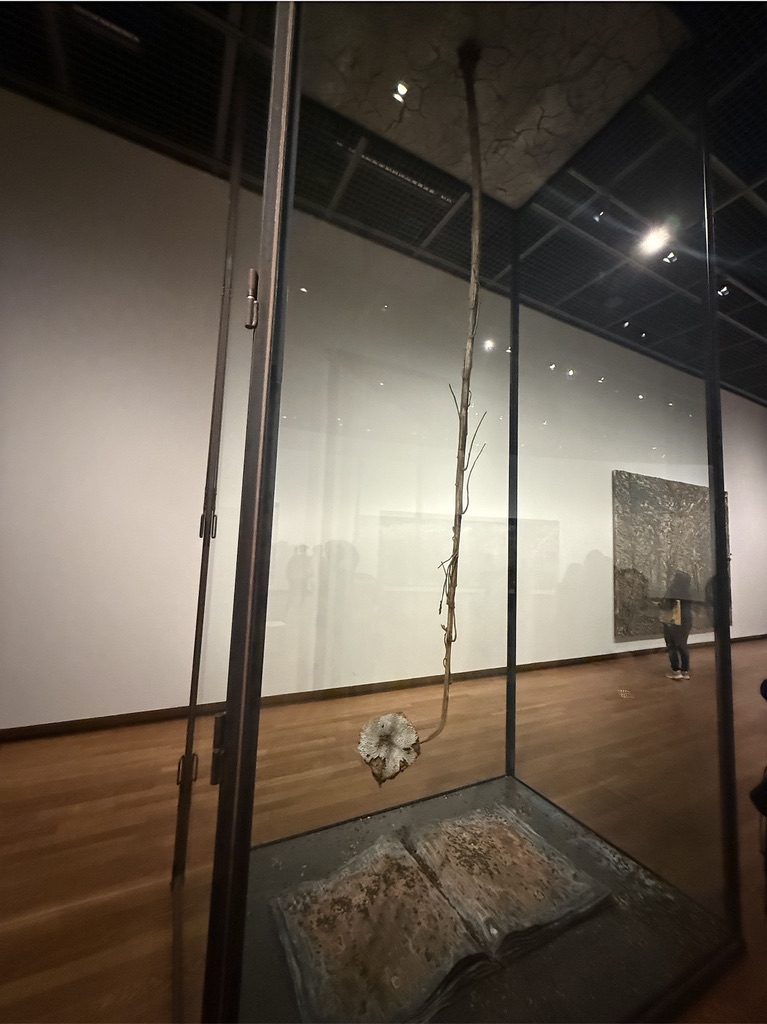
Rising, Rising, Falling Down(2016)–Anselm Kiefer
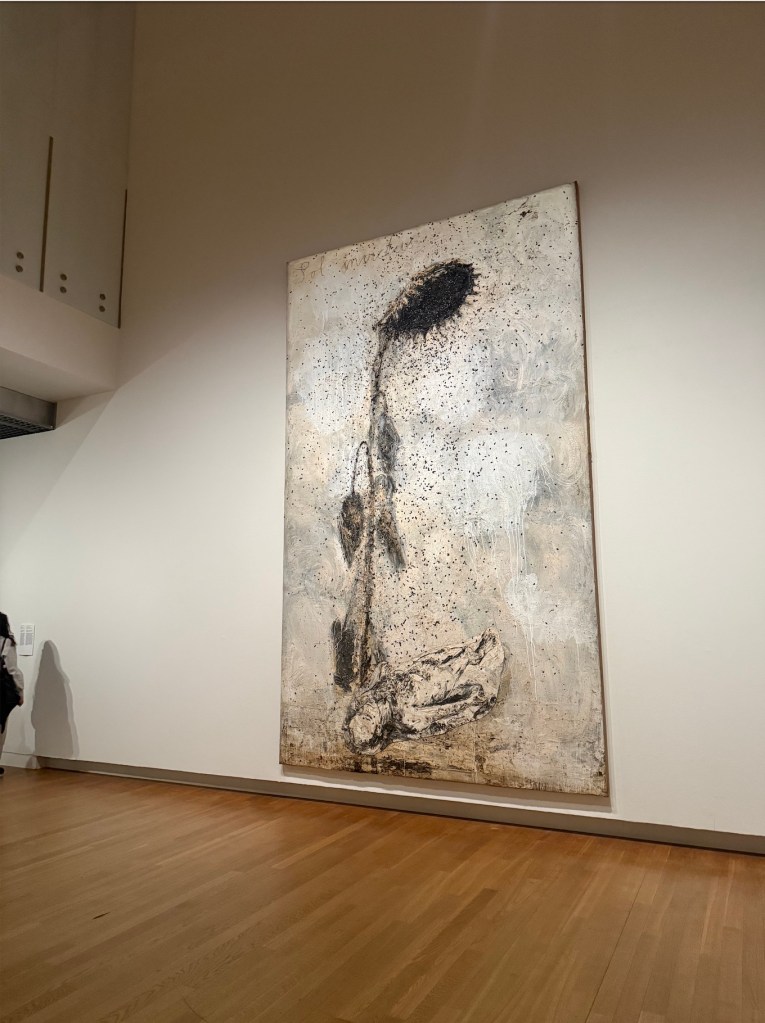
Sol Invictus(1995)-Anselm Kiefer
In the sculpture, a sunflower grows from the ceiling and gradually extends while withering, and eventually turns into a seed. If viewing this as a concept of seeds growing from the ground, death might not just be the end of something, but rather a part of a cycle of life that repeats itself over and over again. The parched ground and withered sunflowers are hanging upside down, facing the book. Here, the media of book can be seen as symbolizing something that remains after death, such as memories, thoughts, and legacy. And the sunflower seeds spread on the book might suggest that the final moments of that life were somehow recorded, passed on, and could grow again.
The name of the sunflower drawing is ‘Sol Invictus’. The concept of the Unconquered Sun reflects an eternal force that cannot be defeated, much like the enduring power of life’s circular path. Kiefer is expressing this symbolization of a subject of power and regeneration. From the drawing of a body that appeared to have lost consciousness on the part of the floor scattered with seeds, the withering of sunflowers was indirectly expressed. Looking closely, I recognized that real sunflower seeds were used. In this work, just like the seeds scattered on the book in the previous sculpture, the fallen seeds fall on the person, and these seeds create a more tragic and cruel atmosphere to the death of the person lying below. This painting has a bright background, but it expresses the existence of death by incorporating the metaphor of the withering of sunflowers and the death of a person. So rather than feeling the direct fear of death, it gave off a strange and creepy atmosphere of death.
Looking at these two sunflower works, I began to see the element of land, where seeds grow into new life, as the place where a seed-like existence returns after its life ends. Thinking about it this way, life and death felt a bit closer to each other. In fact, if you talk about the beginning and end of life, the two feel so far apart, but when you see sprouts sprouting again at the end of the work, isn’t the boundary between life and death really just a hair’s breadth?
Not just the sunflower works, but the works that used natural elements to add texture were also impressive.
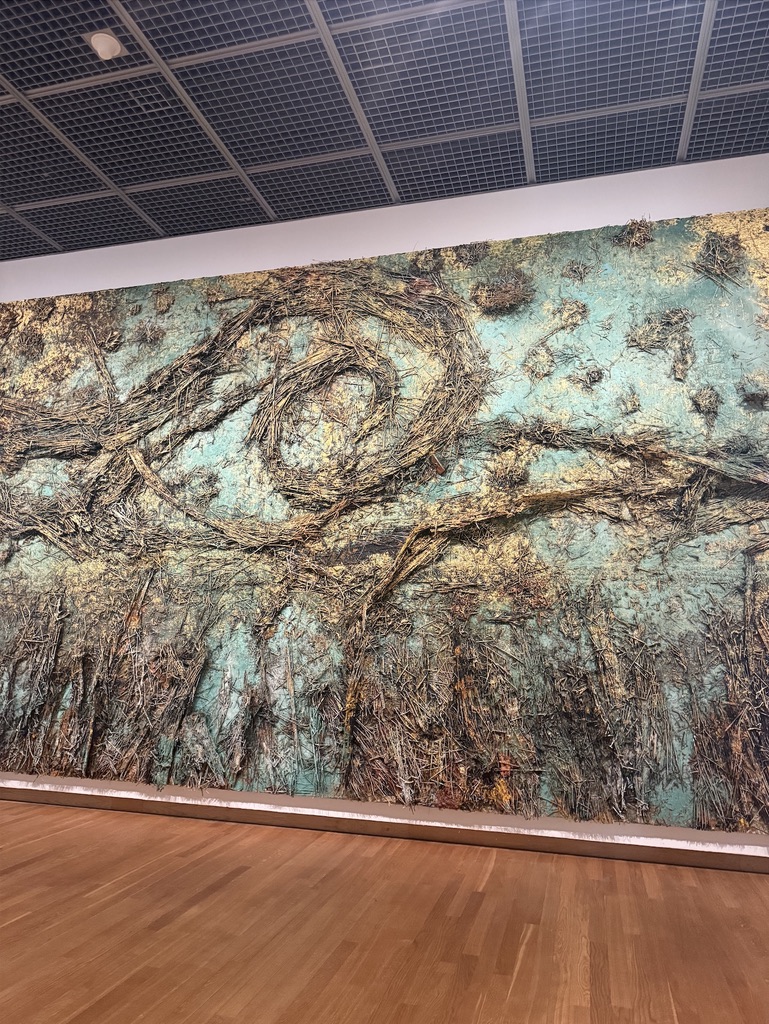
The Starry Night(2019)–Anselm Kiefer
This work is not only unique in its expression of texture, but also draws attention for reminding us of Van Gogh’s popular and famous ‘Starry Night’. In fact, this work is an homage to ‘Starry Night’ from Van Gogh. This shows a bond, which might be a little one-sided, between the two artists in different eras. If Van Gogh’s ‘Starry Night’ shows a dark and serene landscape from a city, Kiefer’s ‘Starry Night’ is closer to a wind blowing through the forest in the middle of the day.
But the wind blowing through the forest in the middle of the day is not always cool and pleasant. As I mentioned earlier, since Kiefer’s works are deeply connected to the darker aspects of World War II, I thought that, despite his use of bright colors, some viewers might feel uneasy or even frightened. I think Kiefer’s signature use of texture creates a sharp, almost cutting feeling.
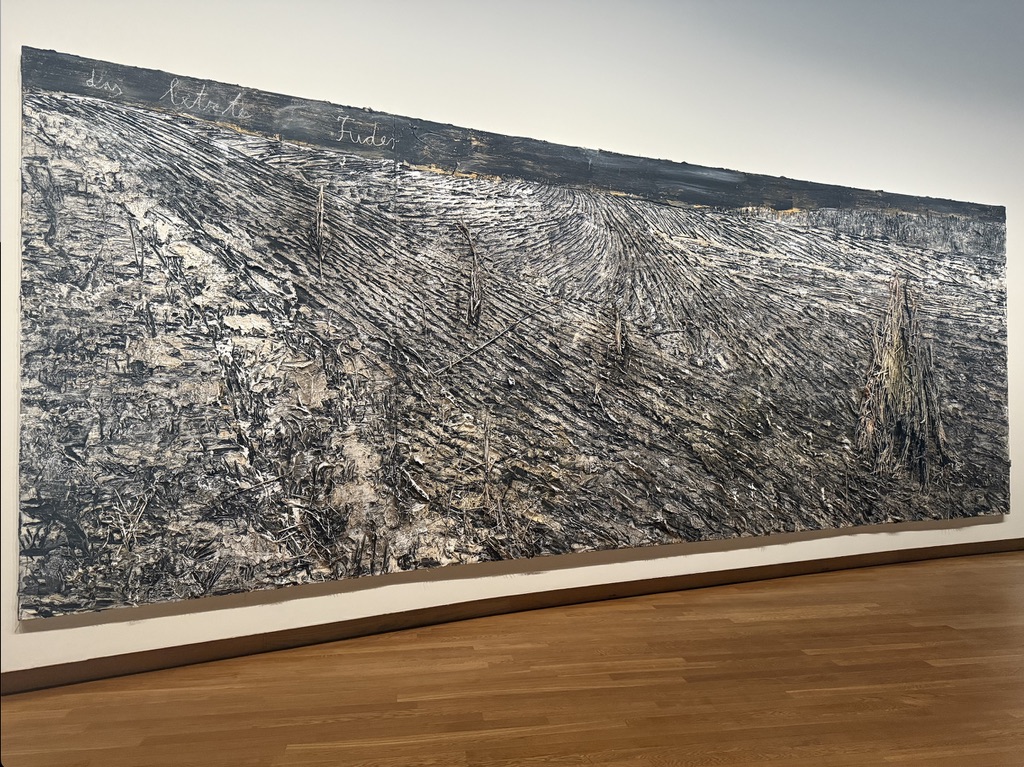
Das Letzte Fruder(2019)-Anselm Kiefer
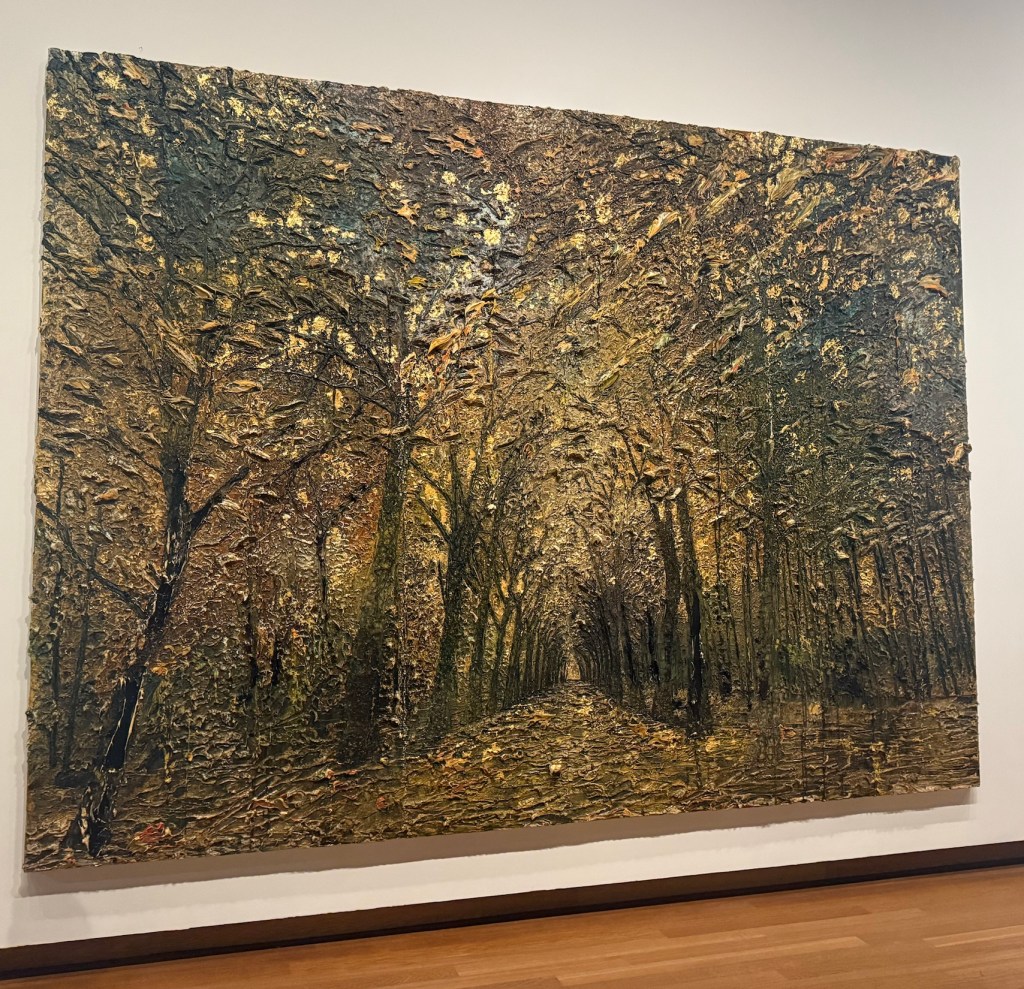
Waldsteig (2023) – Anselm Kiefer
Even though there were lots of dull and dark paintings, that forest road painting gives comfort in another way. Expressing texture in a painting helps show the artwork more deeply, no matter what kind of mood it has. When a painting has depth, the artist can express what he wants to say or what he wants to express more accurately and delicately. I personally have only expressed texture by drawing it, but I have never expressed texture using actual materials. Maybe starting to do that will help me express the depth of a painting more realistically.

This is a photo of the second floor of the exhibition hall. If the first floor showed the connection between Van Gogh and Kiefer, the second floor displays works in the modern style that Kiefer pursued. However, I wanted to focus on the differences between Van Gogh and Kiefer, and Kiefer’s works influenced by Van Gogh. Also the atmosphere of the second floor and the colors used in the paintings seemed lifeless and strange, so the second floor didn’t catch my attention as much as the first floor. So I didn’t take any pictures and just looked around. But when I got home and looked it up, I found out that Kiefer spent his childhood during World War II, and that it continued to influence his work even after he became an artist. Was that why I felt a sense of emptiness and futility when I saw the beautiful but dark landscape paintings?
My overall impression of the museum is that it was an exhibition where I could feel the appeal of Anselm Kiefer, even though I didn’t know much about him before. Of course, I would have liked to see more of Van Gogh’s masterpieces, but it was a great experience to discover Anselm Kiefer. If I get the chance next time, I’d like to take more time to understand and analyze his modern artworks, especially those influenced by the war.
 The Palette Passport
Leave a comment